What is a Q-Switched laser? How many laser tattoo removal sessions are needed, does it scar and does it fully clear
- 1What is a Q-Switched laser?
- 2Which ink colors does each Q-Switched wavelength treat?
- 3Q-Switched or Pico laser tattoo removal: what's the difference?
- 4How many laser tattoo removal sessions? How much does it cost?
- 5Does laser tattoo removal leave scars, and does it fully clear?
- 6Who should and shouldn't get laser tattoo removal?
- 7Why choose laser tattoo removal at Foxy M.D Da Nang?
- 8Conclusion
- 9Quick summary of this article
- 10Frequently asked questions

1 What is a Q-Switched laser?
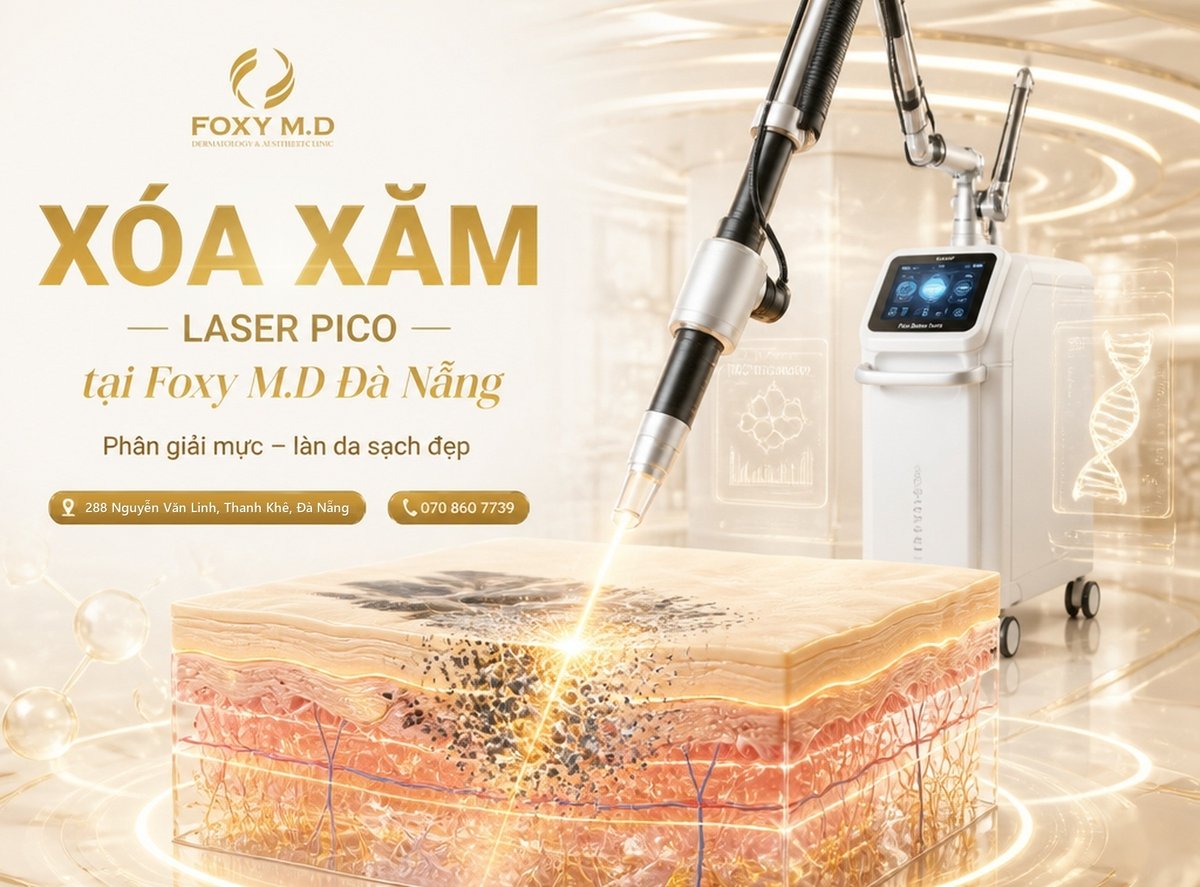
A Q-Switched laser emits ultra-short pulses in the nanosecond range with very high peak power. The energy is delivered so quickly that ink or pigment particles shatter before much heat can spread to the surrounding tissue.
The Q in Q-Switched (quality switching) refers to a technique inside the device: energy is stored and then released all at once as a very short pulse, instead of being emitted continuously. This lets the laser create a photomechanical effect – like a tiny impact that breaks up ink particles – rather than mainly heating the tissue like long-pulse lasers.
Q-Switched lasers have been used in dermatology for decades for pigmented lesions: tattoo removal, freckles, age spots, some types of pigmented birthmarks, and as a supporting melasma treatment in low-energy mode. At Foxy M.D, Q-Switched technology is part of the Chrome Lase Station system by Quanta System (Italy), with multiple handpieces so the doctor can choose for each type of lesion.
2 Which ink colors does each Q-Switched wavelength treat?
Each ink color absorbs a different wavelength: 1064 nm suits black and blue-black ink; 532 nm suits red and orange ink; 694 nm (Ruby) suits green and blue ink. Multicolored tattoos usually require a combination of wavelengths.
The table below shows the general principles of Q-Switched lasers in the medical literature, helping explain why black tattoos usually fade faster than multicolored ones. The doctor will decide on the specific wavelength and handpiece after the examination:
| Q-Switched wavelength | Ink colors absorbed well | Notes |
|---|---|---|
| 1064 nm (Nd:YAG) | Black, blue-black, gray | Penetrates deep, affects skin pigment less, commonly used on many skin tones |
| 532 nm (frequency-doubled Nd:YAG) | Red, orange, pink, some yellow tones | Works superficially, more likely to cause redness and temporary pigment changes |
| 694 nm (Ruby) | Green, blue | Useful for difficult colors; Foxy M.D has a Rosso Ruby 694 nm handpiece |
| White, skin-tone and pastel inks | Respond poorly | May darken after the first pulse; the doctor needs to test a small area first |
3 Q-Switched or Pico laser tattoo removal: what's the difference?
Q-Switched emits nanosecond pulses, while Pico emits picosecond pulses about a thousand times shorter, so it breaks ink into smaller particles. Both can remove tattoos; the doctor chooses based on ink color, depth, the number of previous removal sessions and each person's skin tone.
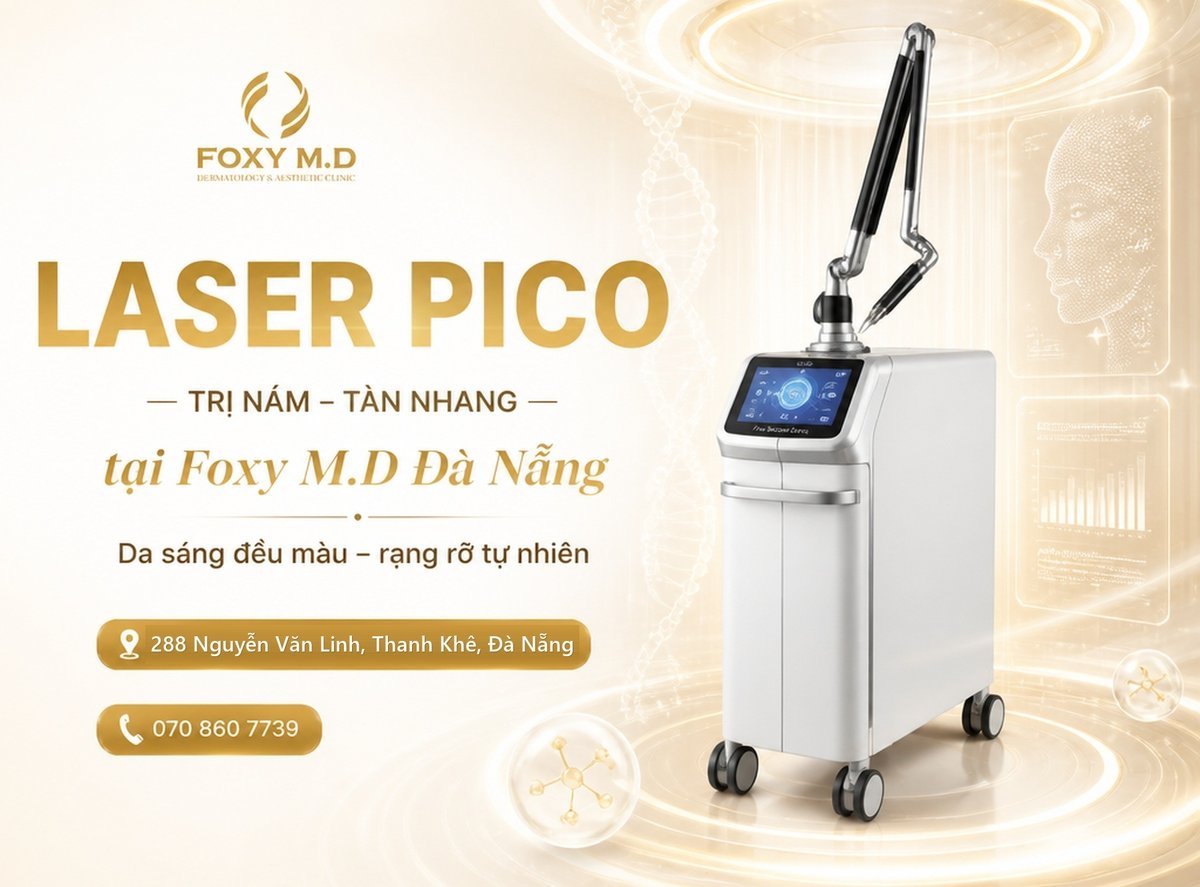
Many people think Pico is always better. In reality, for common black and blue-black ink, Q-Switched is still an effective and widely used tool; Pico has an advantage with ink particles already broken down after many sessions or with some difficult colors. Foxy M.D has both technologies, so they can be combined in the same treatment course. Read more about Pico technology in the article Pico laser tattoo removal in Da Nang.
| Criteria | Q-Switched (Chrome Lase-Station) | Pico (Laser Pico Allux-Q) |
|---|---|---|
| Pulse duration | Nanoseconds | Picoseconds |
| Main mechanism | Photomechanical, with some heat | Predominantly photomechanical, less heat |
| Strengths | Black and blue-black ink; Ruby 694 nm handpiece for green and blue | Small leftover ink particles, tattoos treated many times, some difficult colors |
| After treatment | Redness, swelling, possible mild blistering, scabbing for a few days | Similar, milder in many cases |
| Choice | As prescribed by the doctor | As prescribed by the doctor |
4 How many laser tattoo removal sessions? How much does it cost?
According to the Foxy M.D menu (effective from 10/03/2026), tattoo removal starts from $21 per session depending on tattoo size, with large tattoos priced by area. A treatment course is usually 3–5 sessions depending on size, spaced 2–3 weeks apart, with each session taking 30–45 minutes including numbing.
These numbers are typical; professional tattoos with dense ink, multiple layers, multiple colors or cover-ups may need more sessions. Amateur tattoos, thin ink and old faded tattoos usually fade faster. The doctor estimates the number of sessions after the examination and adjusts it after each assessment.
| Tattoo removal services (menu from 10/03/2026) | Price / session |
|---|---|
| Small tattoo | From $21 |
| Medium tattoo | From $41 |
| Large tattoo | Based on size |
Ink color
Black and blue-black ink usually fade quickly; green, yellow, white and skin-tone inks respond more slowly.
Ink density and depth
Professional tattoos with dense, deep ink or multi-layer cover-ups need more sessions.
Tattoo location
Areas closer to the heart, such as the chest and neck, usually clear faster than the wrists and ankles.
Body and lifestyle
Your immune system, smoking and aftercare all affect how quickly the ink is cleared.
5 Does laser tattoo removal leave scars, and does it fully clear?
When the doctor chooses the right energy and you follow proper aftercare, the risk of scarring is low but not zero. Most tattoos fade significantly after the treatment course, and many become almost invisible, but some may leave a faint shadow.
After each session, the tattooed area usually turns white for a few minutes, then becomes red and swollen, may blister slightly and scabs over within a few days. Temporary hyperpigmentation or hypopigmentation may occur, especially on darker skin or with early sun exposure. If the old tattoo caused a scar when it was done, that scar will remain after the ink fades.
Aftercare largely determines the risk of scarring:
Don't pick or rub scabs
Let scabs fall off on their own; picking them early increases the risk of scarring and infection.
Keep it clean, apply medication as instructed
Clean gently and use the ointment or recovery cream prescribed by your doctor.
Protect the tattooed area from the sun
Cover up and use sunscreen once the skin has healed to limit pigment changes.
Temporarily avoid hot water and swimming pools
No saunas or swimming for the first few days while the skin is still blistered or scabbed.
6 Who should and shouldn't get laser tattoo removal?
Suitable for people who want to remove or fade an old tattoo, a botched tattoo or a faded eyebrow tattoo, or who need fading for a cover-up. Avoid it if you are pregnant, or if the tattooed skin is inflamed, infected, recently sunburned or prone to keloid scars.
Usually suitable:
- Black or blue-black tattoos you want removed or faded.
- Botched or misaligned tattoos, eyebrow tattoos, or old lip tattoos that have changed color (the doctor needs to examine the ink colors carefully).
- Want to fade a tattoo before getting a new one over it.
Postpone or consider carefully:
- Pregnancy or breastfeeding.
- Tattooed area that is inflamed, has eczema, is infected or recently sunburned.
- History of keloid scars, bleeding disorders, or taking medication that causes light sensitivity.
- Tattoos with white, skin-tone or pastel ink – a small test area is needed first.
Eyebrow tattoos have their own specifics because they are close to the eyes and on a hair-bearing area; see also the article laser eyebrow tattoo removal.
7 Why choose laser tattoo removal at Foxy M.D Da Nang?
Foxy M.D has both the Q-Switched laser on the Chrome Lase Station system and the Pico Allux-Q laser; a dermatologist examines ink color, depth and skin tone to choose the right technology, and tattoo removal prices are clearly listed by tattoo size.
- Two technologies in one clinic: Q-Switched (Chrome Lase Station, Quanta System – Italy) and Pico Allux-Q, which can be combined at different stages.
- Examined in person by a doctor: assessment of tattoo ink, depth and scarring tendency before adjusting energy.
- Transparent pricing: based on the tattoo removal service menu, with the expected number of sessions given upfront.
- Monitoring after each session: follow-up visits to assess fading and skin condition. See more services in the Laser & Advanced Technology group.
8 Conclusion
A Q-Switched laser is a nanosecond-pulse laser that breaks up ink and pigment particles, and it remains an effective tattoo removal technology. Laser tattoo removal usually takes 3–5 sessions, and the risk of scarring is low with proper technique and aftercare, but results vary from tattoo to tattoo.
Before starting, let a doctor look at your tattoo in person: ink color, density and location will determine whether Q-Switched, Pico or a combination is most suitable, and roughly how many sessions you need. Book a consultation with a Foxy M.D doctor via the hotline 070 860 7739 – 093 157 1185 or visit the clinic at 288 Nguyen Van Linh, Thanh Khe, Da Nang.
9 Quick summary of this article
- A Q-Switched laser emits high-power nanosecond pulses that break up ink and pigment particles through a photomechanical effect.
- Each ink color suits a specific wavelength: 1064 nm for black, 532 nm for red – orange, Ruby 694 nm for green – blue.
- Foxy M.D has both Q-Switched (Chrome Lase Station) and Pico Allux-Q; the doctor chooses based on the tattoo ink and skin tone.
- Menu price: tattoo removal from $21 per session depending on size, large tattoos priced by area; usually 3–5 sessions, 2–3 weeks apart.
- The risk of scarring is low with proper treatment and aftercare, but not zero; some tattoos may leave a faint shadow.
10 Frequently asked questions
1. Does laser tattoo removal leave scars?
The risk of scarring is low when the doctor chooses the right energy and you follow proper aftercare: don't pick at scabs, keep the area clean and avoid the sun. Still, the risk is not zero, especially for people prone to keloid scars or who rub the scabbed area. If the tattoo already left a scar when it was done, that scar will remain after the ink fades.
2. How many laser tattoo removal sessions does it take?
According to the Foxy M.D menu, a treatment course is usually 3–5 sessions depending on size, spaced 2–3 weeks apart. Amateur tattoos, thinly applied ink or already faded tattoos may need fewer sessions; dense professional tattoos, multicolored tattoos or cover-ups often need more. The doctor reassesses after each session.
3. Does laser tattoo removal completely remove a tattoo?
Most tattoos fade significantly after the treatment course, and in many cases become almost invisible, especially with black ink. Some multicolored tattoos or those with white or skin-tone ink may leave a faint shadow. The doctor will explain the level of improvement you can expect after looking at the ink colors, depth and location of the tattoo.
4. Does laser tattoo removal hurt?
The sensation is usually described as a rubber band snapping against the skin with mild burning. Foxy M.D applies a numbing cream before treatment, and each session takes about 30–45 minutes including numbing time, so most clients find it tolerable. Bony areas such as the wrists and ankles are usually more sensitive than areas with more soft tissue.
5. Q-Switched or Pico: which is better for tattoo removal?
There is no single answer for every tattoo. Q-Switched works well on black and blue-black ink and has a Ruby handpiece for green and blue; Pico has an advantage with small leftover ink particles or tattoos that have already been treated many times. At Foxy M.D, the doctor can combine both at different stages.
6. How soon after tattoo removal can I get a new tattoo?
Wait until the skin has fully healed after the final session and the doctor has checked it, usually several weeks or more depending on your skin. If you are only fading the tattoo for a cover-up, the doctor and tattoo artist will agree on how faded it needs to be. Getting re-tattooed before the skin has healed can easily cause inflammation, scarring and uneven ink.
Article edited from a post dated 26/09/2026 on the Foxy M.D Fanpage.