Common types of acne: how to identify each type and treat it correctly to limit marks and scars
- 1How does acne form?
- 2What types of acne are there? A quick comparison table
- 3Non-inflamed acne: blackheads, whiteheads and closed comedones
- 4Inflamed acne: papules, pustules, nodules and cysts
- 5Who can care for their skin at home, and who should see a dermatologist?
- 6Cost of treating different types of acne at Foxy M.D
- 7Why choose Foxy M.D in Da Nang for acne treatment?
- 8Conclusion
- 9Quick summary of this article
- 10Frequently asked questions

1 How does acne form?
Acne forms when pores are clogged by sebum and dead skin cells, creating a comedone. If C. acnes bacteria multiply in the clogged pore and cause inflammation, the comedone turns into an inflamed spot, a pustule or a nodule.
Four main factors work together: oil glands producing excess sebum (often due to hormones), abnormal keratinization at the opening of the hair follicle that stops dead cells from shedding, C. acnes bacteria (formerly called P. acnes) multiplying, and the body's inflammatory response. If one factor is missing, acne stays at that stage; when all four are present, acne becomes inflamed.
So the types of acne are not separate from each other but different stages of the same process. A closed comedone today can become a red, inflamed spot a few days later if it is squeezed incorrectly or the skin is irritated. Understanding this helps you act early, before acne has a chance to leave marks and scars.
Common factors that make acne worse among Vietnamese people include cyclical hormonal changes, stress, lack of sleep, pore-clogging cosmetics, touching the face, face mask friction and the hot, humid climate.
2 What types of acne are there? A quick comparison table
Acne falls into two groups: non-inflamed acne, including blackheads, whiteheads and closed comedones; and inflamed acne, including papules, pustules, nodules and cysts. Each type has different signs and requires different treatment.
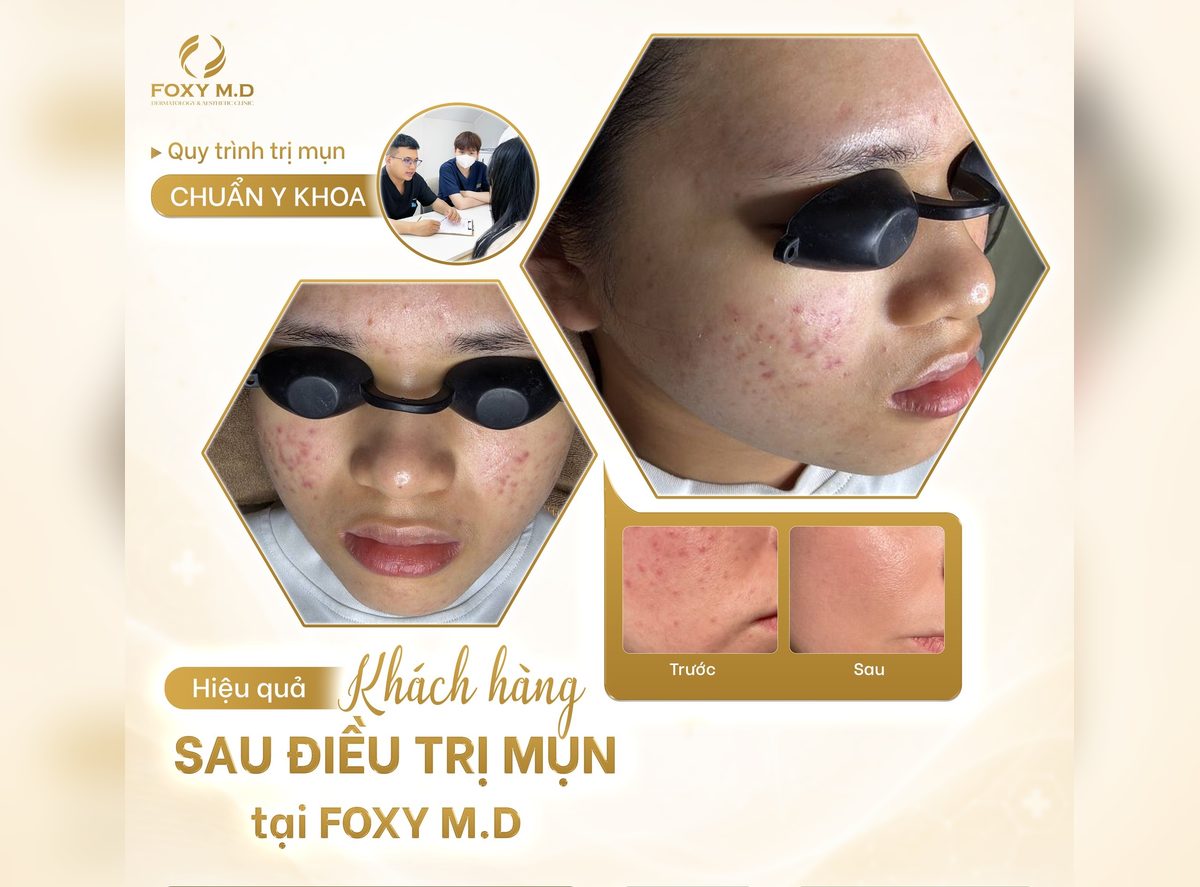
The poster at the top of this article, shared by Foxy M.D on its fanpage, illustrates the three most common types: closed comedones, inflamed acne and blackheads. The table below goes further so you can compare for yourself before your consultation.
| Type of acne | How to recognize it | Common locations | Should you squeeze it yourself? |
|---|---|---|---|
| Blackheads | Open comedone, dark tip due to oxidation | Nose, forehead, chin | Do not use your fingers; use proper extraction technique |
| Whiteheads | Small raised bump with a white head, closed comedone | Forehead, cheeks, chin | Do not squeeze before it is ready |
| Closed comedones | Bumpy under the skin, felt more than seen | Forehead, both cheeks | No; they can easily turn into inflamed acne |
| Papules | Red, swollen bump, tender to touch, no pus yet | Cheeks, chin, jawline | Do not squeeze |
| Pustules | Inflamed bump with a whitish-yellow pus head | Cheeks, chin | Only treat once it has come to a head, at a clinic |
| Nodules, cysts | Large, deep, painful swelling that lasts | Jawline, cheeks, back | Never squeeze; needs a doctor |
3 Non-inflamed acne: blackheads, whiteheads and closed comedones
Non-inflamed acne consists of clogged comedones that are not yet inflamed. Blackheads are open comedones, whiteheads are closed comedones, and closed comedones beneath the skin surface cause a bumpy texture. This is the easiest stage to control if treated correctly.
Blackheads have an open follicle opening; the sebum is exposed to air and oxidizes, which turns it black, not dirt. They usually cluster in the T-zone and come with enlarged pores.
Whiteheads have a comedone covered by a thin layer of skin, looking like a small white dot. Closed comedones are comedones that sit deeper; the surface only looks bumpy when you tilt your face under the light. Learn more in our article what are closed comedones.
General approach: cleanse properly, use actives that help unclog pores as directed, have comedones extracted with sterile instruments at a medical facility, and get regular deep cleansing such as Aqua Peel deep cleansing when prescribed by a doctor.
4 Inflamed acne: papules, pustules, nodules and cysts
Inflamed acne is a comedone affected by bacteria and an inflammatory reaction, ranging from red, swollen, painful bumps to pustules and deep nodules. The deeper the inflamed acne, the higher the risk of dark marks and atrophic scars, so it needs early treatment.
A papule is a red bump that hurts when touched and has no pus yet. When white blood cells gather, the inflamed bump forms a pus head called a pustule. Nodules and cysts sit deep in the dermis, are large and swollen, last for weeks and easily destroy collagen, leaving depressed scars.
This group should not be treated at home. Squeezing before the spot has come to a head pushes inflammatory fluid further, making it larger and leaving a mark. The detailed reasons are in our article should you squeeze inflamed acne. At the clinic, the doctor may use light therapy to reduce inflammation, such as DPL treatment for inflamed acne, acne peels, prescribed topical or oral medication, and anti-inflammatory injections for nodules when needed.
Note: signs you should see a doctor early
Large, painful nodules, rapidly spreading acne, acne with fever, or acne that has already left depressed scars. Late treatment increases the risk of scars that are hard to improve.
Not every bump is acne
Folliculitis, fungal acne, skin tags or warts can look like acne but are treated completely differently.
5 Who can care for their skin at home, and who should see a dermatologist?
People with only a few blackheads and whiteheads can start with proper home care. People with a lot of inflamed acne, nodules, acne lasting more than 2–3 months, or existing marks and scars should see a dermatologist early.
You can try home care first if:
- You have only a little acne, mainly blackheads and whiteheads in the T-zone.
- There are no swollen, painful bumps and no marks or scars.
You should see a doctor if:
- You have many inflamed spots and pustules that keep coming back in cycles.
- You have nodules or cysts on the jawline or back.
- You have used acne products for 6–8 weeks without improvement.
- Your skin shows dark marks or atrophic scars.
- You suspect your acne is caused by hormones, medication or cosmetics.
Back acne has its own characteristics; you can read our article on back acne and back dark spot treatment.
6 Cost of treating different types of acne at Foxy M.D
According to the Foxy M.D price list from 10/03/2026, single acne skincare sessions start from $8/session depending on the service, and the 5-session acne treatment package starts from $107. The doctor prescribes after the consultation.
Non-inflamed acne usually only needs regular skincare and extraction, while extensive inflamed acne needs a combined treatment course. Package details are in our article on medical-standard acne treatment packages.
| Service (Foxy M.D menu) | Listed price | Suitable for |
|---|---|---|
| Basic Facial | From $8 | Skin with minimal acne |
| Acne Facial | From $13 | Moderate to severe acne, acne extraction |
| DPL | From $25 | Inflamed acne, red marks |
| Detox CO2 | From $25 | Helps reduce inflamed acne |
| Deep Cleansing (Aqua Peel and RF) | From $29 | Blackheads, closed comedones, clogged pores |
| Acne peel (Comodex / Recovery / Redness) | From $29 | Reduces oiliness and inflammation |
| 5-session acne package: Basic / Standard / Premium | From $107 / from $154 / from $308 | Combined treatment course based on severity |
7 Why choose Foxy M.D in Da Nang for acne treatment?
At Foxy M.D, dermatologists examine and analyze your skin to identify the exact type of acne and its cause, then combine sterile acne extraction, light therapy, peels and medication in a personalized treatment plan to limit marks and scars.
- Classifying the acne and finding the triggers (hormones, cosmetics, habits) before treatment.
- Acne extraction with sterile instruments, treating inflamed and non-inflamed acne separately.
- DPL Spectra, Celluma bio-light therapy, Aqua Peel and acne peels available to combine by stage.
- Follow-up after each session, adjusting the treatment plan as the acne changes.
See more of Foxy M.D's facial care services.
8 Conclusion
Each type of acne is a different stage of the same clogging and inflammation process. Identifying the right type helps you avoid squeezing incorrectly, act early and limit marks and scars later.
Blackheads, whiteheads and closed comedones can be controlled fairly well with proper care. Inflamed acne, pustules and nodules need a doctor's assessment because of the high risk of scarring. Do not let your skin suffer more damage from word-of-mouth remedies.
If you are in Da Nang, book an appointment at Foxy M.D Dermatology & Aesthetic Clinic, 288 Nguyen Van Linh, Thanh Khe, Da Nang, hotline 070 860 7739 – 093 157 1185 for a skin analysis and advice on a suitable treatment plan.
9 Quick summary of this article
- Acne falls into two groups: non-inflamed (blackheads, whiteheads, closed comedones) and inflamed (papules, pustules, nodules, cysts).
- The types of acne are different stages of the same process of clogged pores and inflammation.
- Inflamed acne and nodules should not be squeezed yourself, as this easily spreads inflammation and leaves dark marks and atrophic scars.
- Foxy M.D menu prices: single acne skincare sessions from $8/session, 5-session acne package from $107.
- Acne that lasts, keeps coming back or has already scarred should be examined by a dermatologist.
10 Frequently asked questions
1. What are the common types of acne on the face?
On the face, the most common are blackheads, whiteheads and closed comedones (non-inflamed), and papules, pustules, nodules and cysts (inflamed). Blackheads usually appear on the nose, forehead and chin; closed comedones on the forehead and cheeks; nodular acne often along the jawline. One face can have several types at the same time.
2. Which type of acne is the most serious?
Nodular and cystic acne are considered the most severe forms because they sit deep, stay inflamed for a long time and easily destroy collagen, leaving atrophic or keloid scars. Do not squeeze them yourself or use home remedies. See a dermatologist early to reduce inflammation and limit scarring.
3. How can I tell closed comedones from whiteheads?
Whiteheads rise above the skin surface with a clearly visible small white dot on top. Closed comedones sit deeper; the surface just feels bumpy, they are usually felt more than seen, and they are most visible when you tilt your face under a light. Both are closed comedones and should not be squeezed yourself, as they can easily turn into inflamed acne.
4. Are blackheads caused by dirt?
Not really. The black color of a blackhead comes from sebum in an open pore being exposed to air and oxidizing, not just from dirt. Washing your face too often or scrubbing hard actually irritates the skin and makes it produce more oil. Proper extraction technique and regular deep cleansing work better.
5. When should I see a dermatologist for acne?
If you have cared for your skin properly for 6 to 8 weeks and the acne has not improved, or you have a lot of inflamed acne, painful nodules, or acne that leaves marks and scars, you should see a doctor. An early visit helps identify causes such as hormones, cosmetics or habits, so you can choose a suitable treatment plan and limit scarring.
6. Is acne on the chin and jawline caused by hormones?
Acne concentrated on the chin and jawline, or that flares before your period, is often related to hormones, especially in adult women. However, face mask friction, resting your chin on your hand or cosmetics can also contribute. The doctor will take your medical history and examine you to find the cause before treatment.
Article edited from a post dated 21/10/2026 on the Foxy M.D Fanpage.