What are closed comedones? Their causes, whether to squeeze them, and how to treat them properly
- 1What are closed comedones?
- 2What causes closed comedones?
- 3How closed comedones differ from other types of acne
- 4Should you squeeze closed comedones?
- 5Effective ways to treat closed comedones at home and at the clinic
- 6Who should see a dermatologist for closed comedones?
- 7Cost, and why choose closed comedone treatment at Foxy M.D Da Nang?
- 8Conclusion
- 9Quick summary of this article
- 10Frequently asked questions

1 What are closed comedones?
Closed comedones are closed acne plugs lying beneath the skin's surface that are not yet inflamed, making the skin feel bumpy and uneven to the touch or when you tilt your face under the light. They are a non-inflammatory type of acne but can easily turn into inflamed acne if irritated.
Medically, these "hidden" bumps are classified as closed comedones. The pore is clogged with sebum and keratin cells, but the follicle opening is covered over, so the plug is not exposed like a blackhead. You usually cannot see individual bumps clearly; you just notice that your skin is less smooth and makeup looks patchy.
Closed comedones tend to cluster on the forehead, both cheeks and the chin, and sometimes spread down to the jawline. Many people have dozens to hundreds of small closed comedones and only discover them during a skin analysis or when they start to become red and swollen.
Closed comedones are part of the bigger picture of common types of acne. Understanding this stage correctly helps you treat it before the acne becomes inflamed and leaves dark marks or scars.
2 What causes closed comedones?
Closed comedones form when the oil glands produce a lot of sebum and dead cells do not shed properly, clogging the pores. Contributing factors include hormones, pore-clogging skincare and makeup products, improper cleansing, stress and lifestyle habits.
Not everyone with oily skin gets closed comedones, and people with dry skin can still get them. It is usually a combination of several factors:
- Hormones: androgen changes during puberty, before a period or after stopping birth control pills make the oil glands more active.
- Heavy, oily makeup and sunscreens: especially when makeup is not thoroughly removed at the end of the day.
- Improper cleansing: washing too little or scrubbing too hard can both make the skin produce more oil and build up more keratin.
- Stress and late nights: affect hormones and the skin's ability to recover.
- Hot, humid climate and mask friction: sweat and sebum easily accumulate in the pores.
- Skin damaged by unregulated mixed creams or corticosteroids: often causes many tiny comedones that are hard to treat.
Note: small, uniform, itchy bumps on the forehead, chest or back may be fungal folliculitis rather than closed comedones. The two conditions are treated differently, so a doctor needs to tell them apart.
3 How closed comedones differ from other types of acne
Closed comedones sit under the skin, are not red, rarely hurt and only feel bumpy to the touch. Whiteheads are raised with a white dot, blackheads have an exposed dark plug, and inflamed acne is red, swollen and painful.
The table below helps you compare quickly. If your skin has several types at once, it is a sign you should have a skin analysis for an overall treatment plan.
| Feature | Closed comedones | Whiteheads | Blackheads | Inflamed acne |
|---|---|---|---|---|
| To the eye | Hard to see, uneven skin | Raised white dot | Dark dot in the pore | Red bump, may contain pus |
| Sensation | Rarely painful | Rarely painful | Rarely painful | Painful, swollen |
| Depth | Below the surface | Shallow | Shallow, open follicle | From shallow to deep |
| Risk of marks and scars | Low if not squeezed | Low | Low | Cao |
| Approach | Clear the follicles, extract with proper technique | Extract when appropriate | Extraction, deep cleansing | Reduce inflammation first, do not squeeze |
4 Should you squeeze closed comedones?
You should not squeeze closed comedones yourself. The plug lies under a closed layer of skin, so pressing with your fingers takes a lot of force, which can easily rupture the follicle and cause inflammation, dark marks and pitted scars. Closed comedones should be extracted with sterile tools after the skin has been softened.
Many people notice bumpy skin and try to squeeze it "clean". The result is often a whole cheek turning red, with inflamed pimples appearing a few days later. This is also why closed comedones often "flare up" into inflamed acne after squeezing at home.
At the clinic, closed comedones are usually treated in this order: cleansing, softening the surface, extracting plugs that are shallow enough with sterile tools, then disinfecting and soothing. Plugs that are still deep are left alone and treated gradually with active ingredients, peels or deep cleansing. Details of the procedure are in the article medical-standard acne extraction; if the acne is already inflamed, see also the article should you squeeze inflamed acne.
Do not use fingernails or improvised needles
They can easily cause scratches, infection and dark marks that are slow to fade.
Do not steam your face and then squeeze repeatedly
Frequent hot steaming can dehydrate and irritate the skin and dilate blood vessels.
Do not extract everything in one go
Trying to remove every plug in one session causes widespread damage. Extracting gradually over scheduled visits is safer for your skin.
5 Effective ways to treat closed comedones at home and at the clinic
At home, cleanse gently, use pore-clearing active ingredients as instructed and choose non-comedogenic products. At the clinic, proper extraction, Aqua Peel deep cleansing and acne peels help the skin become smoother faster.
At home:
- Remove makeup thoroughly if you wear sunscreen or makeup; cleanse gently morning and night.
- Use products with pore-clearing active ingredients such as BHA or retinoids as instructed, starting at a low frequency.
- Choose lightweight, non-comedogenic moisturizers and sunscreens.
- Get enough sleep, and cut back on sweets and dairy if you notice more breakouts when you have them.
At the clinic: the doctor may recommend acne extraction, Aqua Peel deep cleansing to draw sebum out of the pores, an acne peel to reduce keratin buildup, or a combined treatment course when there are many closed comedones along with inflamed acne. Closed comedones usually take a few weeks to a few months before the skin is noticeably smoother, because the comedone formation cycle is long.

6 Who should see a dermatologist for closed comedones?
See a doctor if your closed comedones are dense, last more than 2–3 months despite proper care, often turn into inflamed acne, or you suspect your skin has been damaged by unregulated mixed creams. People with only a few closed comedones can start at home.
Suitable for clinic treatment:
- Densely bumpy forehead and cheeks, makeup does not go on smoothly.
- Closed comedones often turn into inflamed acne.
- You have squeezed them many times and have dark marks or mild pitted scars.
- Skin that has used unregulated mixed creams and has many tiny comedones.
Can be monitored at home:
- A few scattered, non-inflamed closed comedones.
- Breakouts that come in cycles and settle with proper care.
Note: do not take oral acne medication without a prescription, as many drugs require monitoring of liver function and blood lipids and cannot be used during pregnancy.
7 Cost, and why choose closed comedone treatment at Foxy M.D Da Nang?
According to the Foxy M.D price list effective from March 10, 2026: Acne Facial from $13, Deep Cleansing with Aqua Peel from $29, Acne Peel from $29, Standard 5-session acne package from $154. The doctor examines your skin and recommends the right service for your closed comedones.
At Foxy M.D, a dermatologist examines you in person, tells closed comedones apart from fungal folliculitis, and decides on extraction, deep cleansing or peels at each stage. Extraction tools are sterile, and Aqua Peel, Celluma bio-light therapy and a range of acne peels are available to combine. See also the facial care group.
| Service (Foxy M.D menu) | Listed price | Suitable for |
|---|---|---|
| Acne Facial | From $13 | Closed comedone extraction, acne skincare |
| Deep Cleansing (Aqua Peel and RF) | From $29 | Clogged pores, bumpy skin |
| Acne peel (Comodex / Recovery / Redness) | From $29 | Reduces oiliness and keratin buildup |
| Standard 5-session acne package | From $154 | Many closed comedones along with inflamed acne |
8 Conclusion
Closed comedones are closed acne plugs beneath the skin that are not yet inflamed but can easily become inflamed if you squeeze them yourself. The right approach is to clear the pores, extract with sterile tools and be patient for a few weeks to a few months.
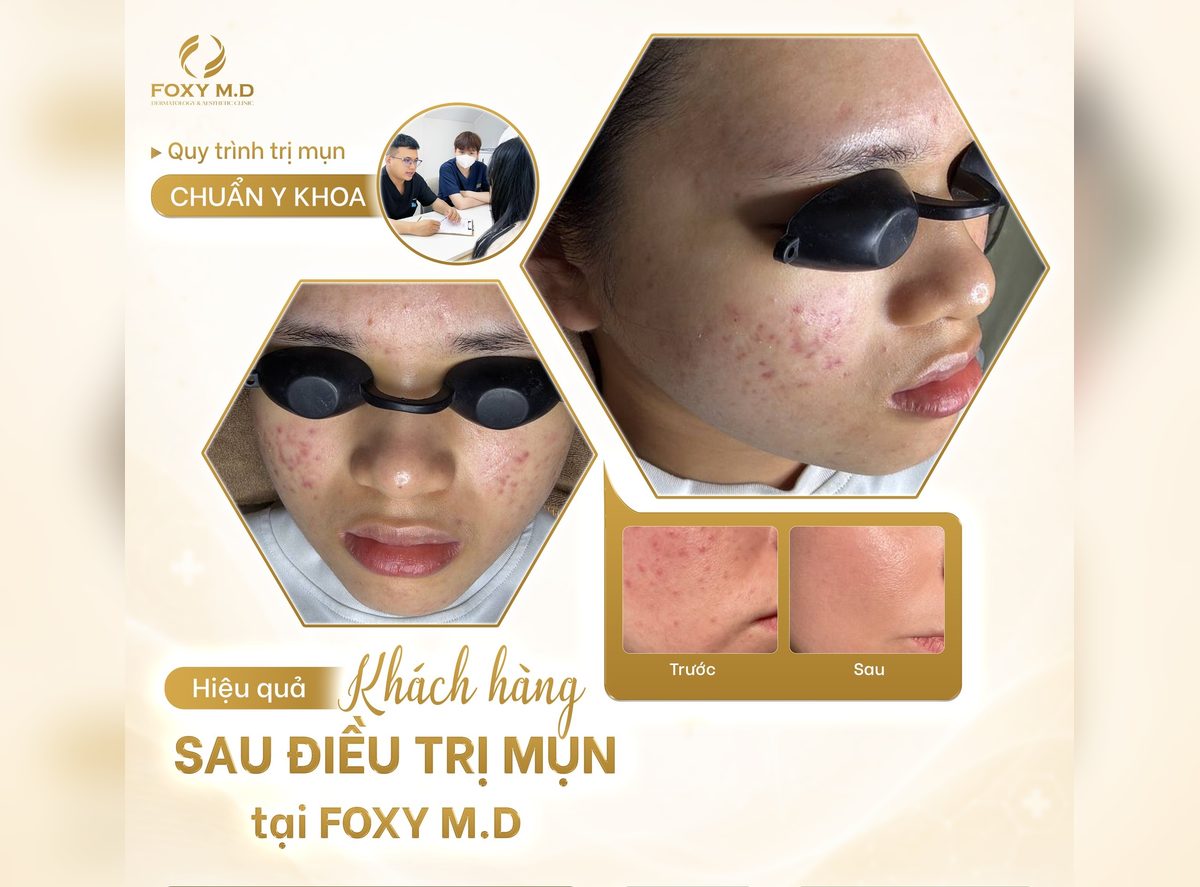
Skin made bumpy by closed comedones can improve noticeably if you stop squeezing, choose suitable skincare products and have them treated with proper technique. The before-and-after images in this article, shared by Foxy M.D on its fanpage, are for illustration only; results vary from person to person.
Book an appointment at Foxy M.D Dermatology & Aesthetic Clinic, 288 Nguyen Van Linh, Thanh Khe, Da Nang, hotline 070 860 7739 – 093 157 1185, to have your skin examined by a doctor and get advice on the right way to treat your closed comedones.
9 Quick summary of this article
- Closed comedones are closed acne plugs beneath the skin that cause bumpiness and are not yet inflamed.
- Cause: sebum and dead cells clogging the pores, driven by hormones, skincare or makeup products and improper cleansing.
- Do not squeeze closed comedones yourself, as this easily causes inflammation, dark marks and pitted scars.
- Foxy M.D menu prices: Acne Facial from $13, Deep Cleansing from $29, Acne Peel from $29, Standard 5-session package from $154.
- Closed comedones usually need a few weeks to a few months of proper care before the skin is noticeably smoother.
10 Frequently asked questions
1. What are closed comedones?
Closed comedones are closed acne plugs lying beneath the skin's surface, forming when sebum and dead cells clog a pore while the follicle opening is covered over. They are not red and rarely hurt; they just make the skin bumpy, which is most noticeable when you touch it or tilt your face under the light. If irritated, closed comedones can turn into inflamed acne.
2. Should you squeeze closed comedones?
You should not squeeze them yourself. The plug of a closed comedone lies under a closed layer of skin, so getting it out requires strong pressure, which can easily rupture the follicle and cause inflammation, dark marks and pitted scars. Closed comedones should be extracted with sterile tools after the skin has been softened, removing only plugs that are shallow enough; the rest are treated gradually with active ingredients.
3. How long do closed comedones take to clear?
It depends on the severity and the cause. With mild closed comedones, proper care usually makes the skin smoother after about 4 to 8 weeks. Dense closed comedones, or those caused by unregulated mixed creams, may need several months of combined extraction, deep cleansing and peels. Keeping a suitable skincare routine helps limit new comedones from forming.
4. What causes closed comedones on the forehead?
Closed comedones on the forehead are usually linked to the oily T-zone, bangs and hair products touching the skin, helmets, sweat and incomplete makeup removal. Stress and late nights also play a part. If the bumps are uniform and itchy, you should be examined to rule out fungal folliculitis.
5. Do closed comedones go away on their own?
Some closed comedones can clear or shrink on their own when you care for your skin properly, but if the cause of clogging remains, new ones will keep forming. For consistently smooth skin, you need to adjust your skincare and makeup products, cleanse appropriately and use active ingredients or supporting treatments as advised by a doctor.
6. Should you go to a spa for closed comedone extraction?
You can have extractions at a place that ensures sterile tools and where the practitioner can tell closed comedones apart from inflamed acne or fungal folliculitis. If your closed comedones are dense, keep coming back or have become inflamed, an examination at a dermatology clinic helps find the cause and coordinate more suitable treatment.
Article edited from a post dated October 21, 2026 on the Foxy M.D Fanpage.