What is Ruby laser? Ruby 694 nm for pigmentation and tattoo removal, and how it differs from Nd:YAG and Pico
- 1What is Ruby laser?
- 2What can the 694 nm ruby laser treat?
- 3How do Ruby, Nd:YAG and Pico lasers differ?
- 4Who should and shouldn't be treated with Ruby laser?
- 5What happens to your skin after Ruby laser, and what should you watch for?
- 6How much does Ruby laser cost at Foxy M.D?
- 7Why choose Foxy M.D Da Nang for Ruby laser?
- 8Conclusion
- 9Quick summary of this article
- 10Frequently asked questions

1 What is Ruby laser?
Ruby laser uses a ruby crystal to emit red light at a wavelength of 694 nm. This wavelength is very strongly absorbed by melanin, so Ruby laser is mainly used to treat benign pigmentation and remove tattoos.
Ruby was the first laser ever built, in 1960. In dermatology, Ruby laser usually runs in Q-switched mode: it emits ultra-short pulses in the nanosecond range with very high peak power. Such short pulses shatter pigment or ink particles before heat has time to spread to the surrounding tissue, following the principle of selective photothermolysis. The fragments are then gradually cleared by macrophages over several weeks.
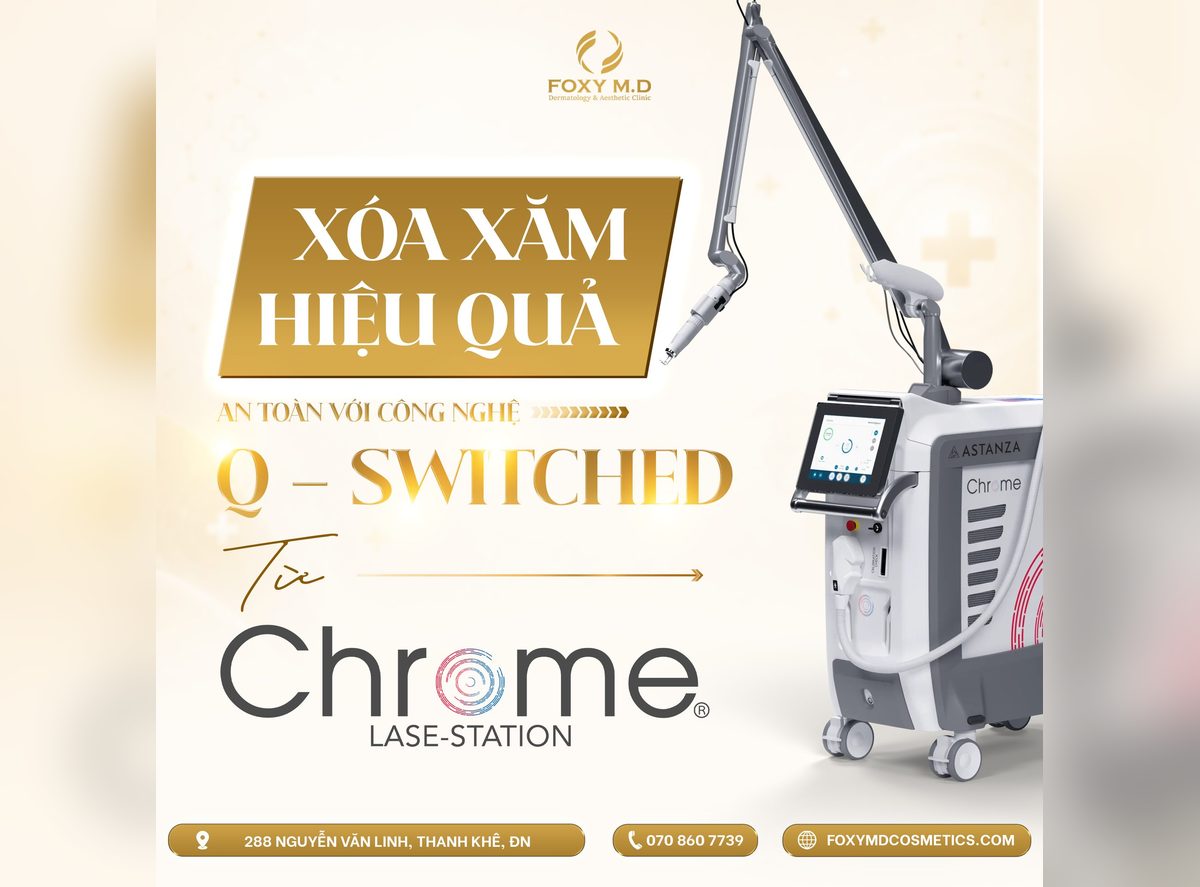
At Foxy M.D, the 694 nm Ruby laser is the Rosso handpiece on the Chrome Lase Station by Quanta System (Italy). The manufacturer's poster shared by Foxy M.D describes Rosso as a new-generation Ruby laser used for melasma, freckles, benign pigmentation and tattoo removal.
2 What can the 694 nm ruby laser treat?
Ruby 694 nm is commonly used for freckles, brown spots, benign pigmentation in the epidermis and dermis, and tattoos with black, blue or green ink. For melasma, Ruby laser is only one option within a protocol and needs careful consideration by the doctor.
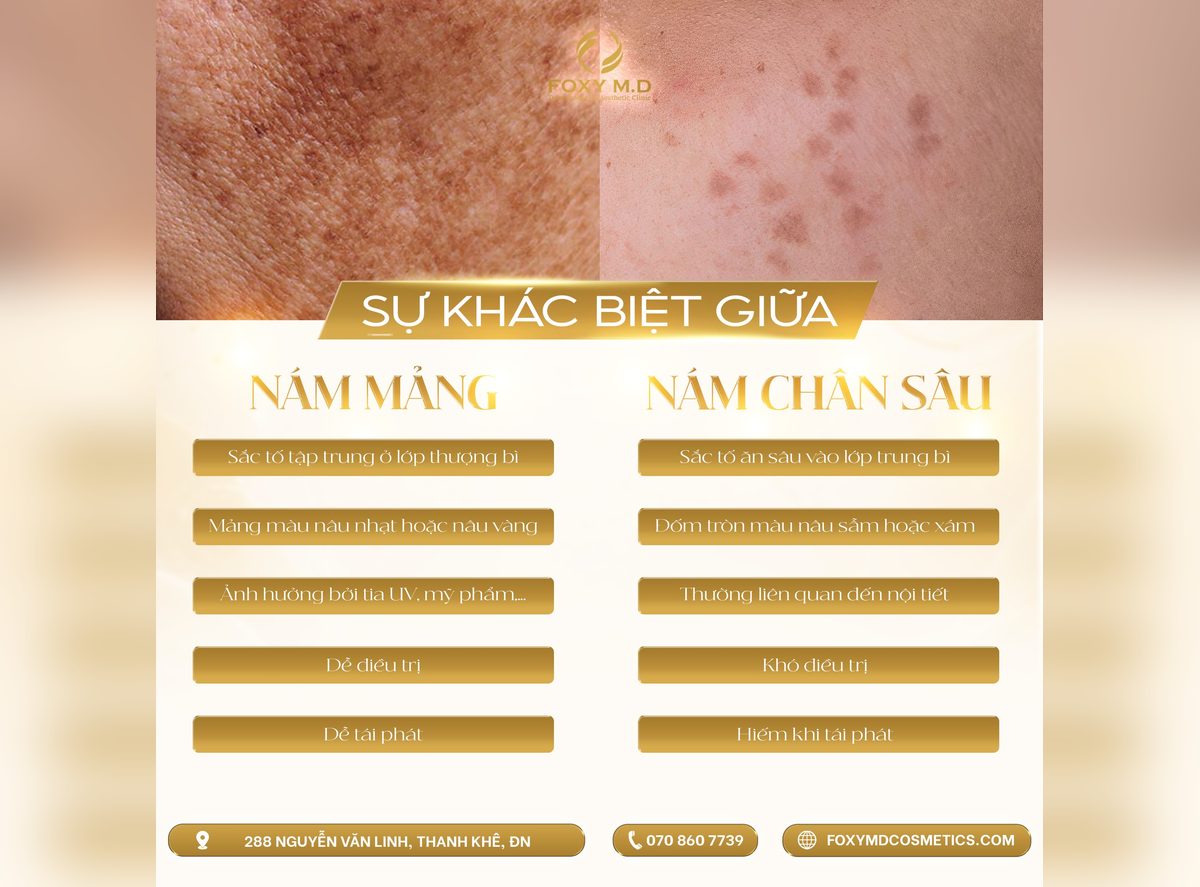
Can Ruby laser treat melasma? It may help, but melasma is not the same as freckles. Melasma is linked to hormones, sunlight and inflammation, recurs easily and can darken if the skin is overstimulated by heat. That is why the doctor usually identifies the type of melasma first (see epidermal vs. deep dermal melasma), then decides which laser to use, at what energy, and how to combine it with topical medication and sun protection. An overview of the protocol is in the article melasma treatment in Da Nang.
Freckles, brown spots
Pigment spots with clear borders in the epidermis usually respond well to the 694 nm wavelength.
Benign pigmentation
Some forms of hyperpigmentation in the dermis, based on a dermatologist's diagnosis and indication.
Tattoo removal
Black, blue and green inks absorb 694 nm well; red, orange and yellow inks respond less well.
Melasma
Only supportive within a combined protocol, with cautious energy and close monitoring for the risk of darkening.
3 How do Ruby, Nd:YAG and Pico lasers differ?
Ruby 694 nm has the strongest melanin absorption, suiting pigmentation and green or blue ink. Q-switched Nd:YAG 1064 nm penetrates deep and has less effect on surface melanin; 532 nm suits red ink. Pico emits shorter pulses, breaking ink and pigment into smaller particles.
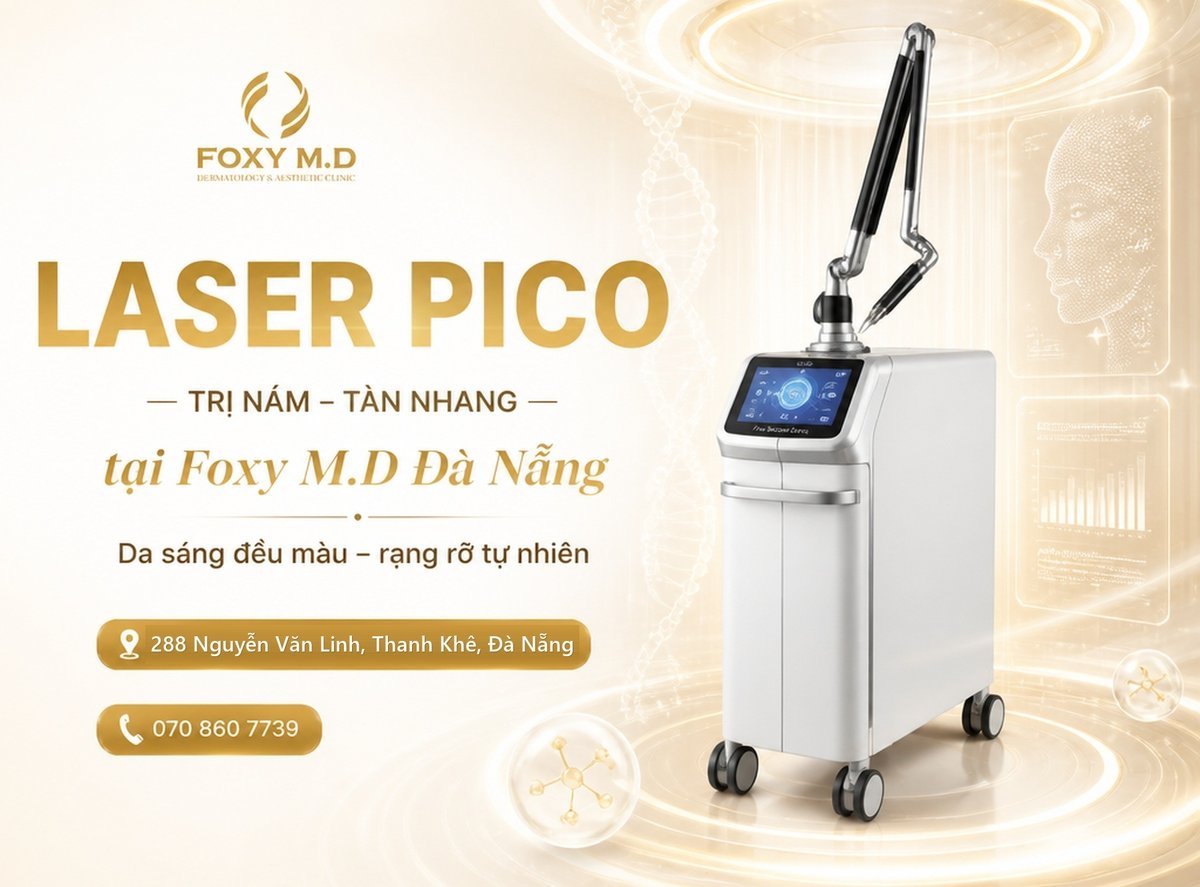
These three technologies are not mutually exclusive. A multicolored tattoo may need the Ruby wavelength for green ink and Pico for ink remaining after several sessions. For darker skin, the 1064 nm wavelength is usually safer than Ruby because it is less absorbed by surface melanin. Foxy M.D has the Chrome Lase Station (including a Ruby handpiece) and the Pico Allux-Q laser; a detailed comparison for tattoo removal is in the article Q-Switched or Pico for tattoo removal.
| Criteria | Ruby Q-switched 694 nm | Nd:YAG Q-switched 1064/532 nm | Pico (Pico Allux-Q) |
|---|---|---|---|
| Pulse duration | Nanoseconds | Nanoseconds | Picoseconds |
| Melanin absorption | Very high | 1064 nm low; 532 nm high | Depends on wavelength |
| Depth of action | Medium | 1064 nm deep; 532 nm superficial | Depends on wavelength |
| Strengths | Freckles, pigmentation, green, blue and black ink | 1064: black ink, deep pigment; 532: red ink, superficial spots | Melasma, freckles, stubborn ink, multicolored tattoos |
| Notes | Risk of temporary hypopigmentation in darker skin | 532 nm can easily cause dark marks on Asian skin | Usually less heat, mild redness |
| Price at Foxy M.D | As prescribed by the doctor | As prescribed by the doctor | From $43/session |
4 Who should and shouldn't be treated with Ruby laser?
Ruby laser suits people with freckles, brown spots, diagnosed benign pigmentation, or tattoos with green, blue or black ink. It should not be done when you are tanned or pregnant, or have infected or inflamed skin or a lesion whose nature is unclear.
Darker skin or skin just back from the beach needs special attention: abundant melanin at the surface "competes" for the energy, increasing the risk of pigment loss or post-inflammatory hyperpigmentation. In these cases, the doctor may postpone treatment or choose a different wavelength.
Worth considering
Freckles, sun-induced brown spots, benign pigmentation, tattoos with green, blue or black ink.
Needs a thorough examination
Long-standing melasma, darker skin, skin that has developed dark marks after laser or acne.
Postpone
Tanned skin, pregnancy, wounds, infection or dermatitis in the treatment area.
Not performed
Pigmented spots that have changed shape or show unusual colors and have not been ruled out as malignant by a doctor.
5 What happens to your skin after Ruby laser, and what should you watch for?
Right after treatment, the area usually turns grayish-white and then mildly red; pigment spots may darken, form a thin crust and flake off after about 5–10 days. Strict sun protection is needed, and don't pick the crusts, to reduce the risk of dark marks.
For tattoo removal, the tattoo fades over several sessions because the body needs time to clear the ink fragments; sessions are usually a few weeks apart. Note: hypopigmentation (skin lighter than the surrounding area) can occur, is usually temporary and improves gradually.
Grayish-white, mild redness
Immediate whitening caused by shattered pigment or ink; it fades after 15–30 minutes, leaving the skin red and warm.
Spots darken
Pigment spots turn darker and may swell slightly; tattooed areas may develop small blisters.
Thin crusts flake off
Let the crusts fall off on their own, keep the area moisturized, apply medication as instructed, and don't pick.
Reassessment
The doctor checks your skin tone and how much the pigment or ink has faded to schedule the next session.
6 How much does Ruby laser cost at Foxy M.D?
The 694 nm Ruby laser (Chrome's Rosso handpiece) does not yet have a listed price on the Foxy M.D menu effective March 10, 2026. It is priced after a doctor's consultation, depending on the type of lesion, the area and the number of sessions.
For reference, some services do have prices on the Foxy M.D menu: Pico laser from $43/session; tattoo removal from $21 for small tattoos, from $41 for medium tattoos, and large tattoos priced by size; brightening peels from $33. These are the prices of those services, not of Ruby laser. If your protocol includes the Rosso handpiece, the doctor will tell you the specific cost before treatment.
7 Why choose Foxy M.D Da Nang for Ruby laser?
Foxy M.D has both the 694 nm Ruby laser on a genuine Quanta System Chrome Lase Station and the Pico Allux-Q laser, so the doctor can choose the wavelength that suits your pigment color, ink color and skin type, instead of using one machine for every case.
With pigmentation, the right diagnosis matters more than a powerful machine. Foxy M.D dermatologists examine and analyze your skin to distinguish freckles, melasma, brown spots or dermal pigmentation before recommending treatment, and monitor you closely after each session to limit dark marks. For tattoo removal, see also Pico laser tattoo removal.
Multiple wavelengths
Ruby 694 nm, Chrome's Q-Switched handpieces and Pico Allux-Q, all in one clinic.
Genuine equipment
The Chrome Lase Station was handed over by Quanta System via TRANFA in September 2026.
Diagnosis by a doctor first
Pigment and ink color are classified before the handpiece and energy are chosen.
Combined treatment plans
Combined with sun protection, topical medication, peels or brightening injections when needed.
8 Conclusion
The 694 nm Ruby laser is a Q-switched laser with strong melanin absorption, suitable for freckles, benign pigmentation and green, blue or black tattoo ink. It should be used cautiously for melasma and darker skin; the choice between Ruby, Nd:YAG and Pico should be based on an examination.
Results of pigmentation treatment and tattoo removal vary from person to person, depending on lesion depth and post-laser care. To have your skin analyzed and get advice on a suitable wavelength, you can book an examination at Foxy M.D, 288 Nguyen Van Linh, Thanh Khe, Da Nang, hotline 070 860 7739 – 093 157 1185.
Read more: What Is the Er:YAG 2940 Laser? Compared With Fractional CO2 · Laser for Facial Spider Veins: How It Works, Sessions, Price
9 Quick summary of this article
- Ruby laser uses a ruby crystal and emits a 694 nm wavelength that is very strongly absorbed by melanin.
- It usually runs in Q-switched (nanosecond) mode to shatter pigment and tattoo ink particles.
- Suitable for freckles, brown spots, benign pigmentation, and black, blue or green tattoo ink; caution is needed for melasma.
- Different from Nd:YAG (1064 nm penetrates deep, 532 nm for red ink) and Pico (picosecond pulses that break particles into smaller pieces).
- At Foxy M.D it is the Rosso handpiece on the Chrome Lase Station; priced after a doctor's consultation.
10 Frequently asked questions
1. What is Ruby laser?
Ruby laser uses a ruby crystal to emit red light at a wavelength of 694 nm. In dermatology, this laser usually runs in Q-switched mode with nanosecond pulses, which are strongly absorbed by melanin and certain ink colors. That is why Ruby laser is mainly used to treat freckles, benign pigmentation and tattoos.
2. How is Q-switched Ruby laser different from regular Ruby laser?
Q-switched mode compresses energy into ultra-short pulses in the nanosecond range, enough to shatter pigment and ink particles before heat spreads to the surrounding tissue. Longer-pulse Ruby lasers generate more heat and were previously used for other purposes such as hair removal. For pigmentation treatment and tattoo removal, Q-switched mode is the common choice.
3. Can Ruby laser treat melasma?
Ruby laser may help in some cases of melasma, but it is not the first-line choice for everyone. Melasma recurs easily and can darken when the skin is stimulated by heat. The doctor needs to determine the type of melasma, its depth and your skin type, then combine laser with sun protection, topical medication or other methods as appropriate.
4. Which tattoo colors can the 694 nm ruby laser remove?
The 694 nm wavelength is well absorbed by black, blue and green ink, so it is often used for these colors, especially green ink, which is difficult to treat with many other lasers. Red, orange and yellow inks respond less well and usually need a 532 nm wavelength or Pico laser. Multicolored tattoos may need a combination of several wavelengths.
5. Is Ruby laser or Pico better?
Each has its own strengths. Ruby is very strongly absorbed by melanin, making it suitable for freckles and green or blue ink. Pico emits shorter pulses, breaks ink and pigment into smaller particles, usually with less heat, and suits stubborn ink and many cases of melasma. Foxy M.D has both, and the doctor chooses or combines them after examining you.
6. Does Ruby laser leave scars?
With the right indication, suitable energy and proper aftercare, the risk of scarring is low but not zero. More common effects are redness, mild blistering, crusting, and temporary darkening or lightening of the skin. Darker skin and tanned skin carry a higher risk, so they need to be assessed by a doctor before treatment.
Article adapted from a post dated September 24, 2026 on the Foxy M.D Fanpage.